The Truth About Scalp Health and Hair Loss & What Your Stylist Should Be Telling You
It All Begins Here
Hair loss is one of the most emotionally loaded things a woman can experience. And it's one of the most underdiscussed topics behind the chair.
I've had clients sit down in my chair and mention that their hair has been thinning. That their ponytail is half the thickness it used to be. That they've started parting their hair differently to cover what's happening at the crown. It can be quite scary when it starts happening, as most of us hold a lot of our identity in how our hair looks.
As a stylist we tend to be one of the first people to notice changes in your hair and scalp health and one of the first people to have an honest conversation with you about it. My chair is a safe space for these conversations as they can
Hair loss in women is more common than anyone talks about
The statistics are striking. Significant hair thinning affects a large portion of women at some point in their lives , and yet it remains one of the most stigmatized and least discussed health topics in women's wellness spaces.
Part of the problem is that female hair loss doesn't always look dramatic. It's rarely the receding hairline associated with male pattern baldness. It shows up as a wider part. Larger clumps of hair in your brush. and a shower drain that's collecting more than it used to. From hair that was once thick and bouncy to seeing more of your scalp.
As women, hair is a huge part of our identity so when this starts happening it can be traumatic.
What your scalp has to do with it
First ill say that hair loss doesn’t necessarily always originate at the scalp. Hormonal shifts, nutritional deficiencies, stress, and thyroid function all play significant roles and those require medical attention beyond what any stylist can address, but scalp health is absolutely part of the picture and it's the part that falls within our world as hair professionals.
A healthy scalp has good circulation, a balanced microbiome, clear follicles, and a moisture barrier that functions properly. When any of those are compromised whether that is through product buildup, chronic inflammation, tension from certain hairstyles or extension methods, or environmental factors like harsh dry winters, our hair growing from that environment is affected.
Thinner. More fragile. Slower growing. More prone to breakage at the root.
Addressing scalp health doesn't replace medical treatment for hormonal or systemic hair loss, but it creates the best possible environment for the hair you do have to thrive.
What chronic tension does to your hairline
This is something I feel strongly about and will always be honest with my clients about , certain hairstyles and certain extension methods cause traction on the hairline and temples over time.
Tight ponytails worn daily. Extensions applied with too much weight for your natural hair density. Beaded weft tracks that create consistent horizontal tension along the same line of hair. Grippy Athletic headbands. These things feel fine in the short term but can cause real damage in the long term.
Traction alopecia (hair loss caused by repeated tension) is one of the most preventable forms of hair loss and one of the most common things I see in women who've had extensions done without proper assessment of their natural hair's ability to support the weight.
This is why I assess every client's hair density and scalp health before any extension application. Adding extensions to a compromised scalp or fragile hairline is something I won't do, not because I want to turn away business but because I genuinely care about what happens to your hair after you leave my chair.
What Alberta's climate specifically does to your scalp
We live in one of the driest climates in Canada. Our winters are brutal, cold dry air outside, aggressively heated air inside, and almost no humidity in between. That combination strips moisture from the scalp consistently for months at a time.
A dry scalp produces a weaker hair shaft. Dry, brittle hair at the root breaks before it reaches length. And when you're already dealing with thinning, losing length to breakage compounds the problem significantly.
Adding a hydrating scalp treatment to your winter routine (like Joico’s Scalp Vitality Replenishing Essence Spray) or a scalp oil massaged in once a week, makes a real difference. Scalp massage itself increases circulation to the follicle which supports healthier hair growth over time. It takes five minutes and costs almost nothing, or you can book in for regular scalp treatments in the seasons when you need it most.
What I wish everyone understood
Your hair is telling you something! The thinning, the texture change, the slow growth, these are signals worth paying attention to and worth discussing openly with the person who has their hands in your hair every few months.
A good stylist notices. A great stylist says something.
I'm not a doctor and I will always refer clients to their physician or a dermatologist when what I'm seeing goes beyond what scalp care can address. But I will always have the honest conversation rather than stay quiet because it's uncomfortable.
You deserve a stylist who looks at your whole hair health picture and tells you the truth about what they see so that you can get back to feeling like your best self sooner then later<3.
Where to start if you're concerned about your scalp health
Start with the basics. Sulfate-free shampoo. Washing every 2-3 days rather than daily or weekly. A monthly clarifying or scalp scrub treatment. A hydrating scalp product through Edmonton's dry season. And a conversation with your stylist at your next appointment, where they can offer you a scalp treatment to help reset everything.
If you'd like to talk about what's happening with your hair and scalp specifically, without judgment, without pressure, and with complete honesty that's exactly what my consultations are for.
Is Your Hair Care Routine Destroying Your Scalp?
It All Begins Here
I have been noticing a shift recently with more clients asking questions on scalp health. In the past most women didn't think about their scalp until something was wrong, and by the time something feels wrong; the itching, the thinning, the hair that won't grow past a certain length, it's already been building up for a while.
Your scalp is skin. And just like the skin on your face, it has a microbiome, a moisture barrier, and a delicate balance that modern hair care routines are constantly working against.
Here's what Ive seen after 18 years behind the chair and the most common reasons why your scalp health is not thriving.
Sign #1 — Your hair stopped growing at the same length
This is one of the most common things I hear in consultation. "My hair just won't grow past my shoulders." The reality is hair almost always is growing. One of the culprits for breaking off at the same rate it's growing, is because the scalp environment isn't supporting strong hair growth from the root.
A compromised scalp produces a weaker hair shaft. Weaker hair breaks before it reaches length. The solution isn't just a growth serum, it's addressing the root cause first. Sometimes it can also be medical where you do need to see a doctor, however if you are having scalp issues I recommend changing up your haircare routine before to see if the problem persists.
Sign #2 — You wash your hair every day because it gets oily fast
This one is a cycle most women don't realize they've trapped themselves in. Washing daily strips your scalp of its natural oils. Your scalp responds by producing more oil to compensate. So you wash again. And the cycle continues.
Your scalp is trying to protect itself. The more you strip it, the harder it works to rebalance. Extending your wash schedule by one day and using a gentle sulfate-free shampoo focused on the scalp will start to break that cycle within a few weeks.
There is a balance though, because not washing your hair enough also creates scalp problems. Your scalp needs to be clean to thrive.
Sign #3 — You have buildup you can see or feel
Product buildup, hard water mineral deposits, and dead skin accumulation on the scalp create a physical barrier at the follicle. Hair can not grow strong through a blocked follicle, instead it starts out growing finer, weaker, and more prone to breakage.
If you’re someone who uses a lot of these products and only washes their hair once a week you are creating an unhealthy scalp environment. Continually adding layers of product before cleansing the old ones off your scalp builds up quickly and blocks the hair follicle.
A scalp scrub or clarifying detox treatment once a month removes that buildup and lets your follicles breathe. This is one of the most underrated things you can do for your hair health and it costs almost nothing. Just a little TLC!
Sign #4 — You colour your hair but never treat your scalp
Colour clients especially — and I say this with love because I am a colour specialist — tend to focus entirely on the hair ends and completely neglect the scalp. We’ve become so focused on making sure our ends get treated to prevent breakage and add moisture, and all of our products at home reflect that. Oils, serums, leave-ins, moisture masks etc are all designed to be used mids/ends down so the scalp never gets fully treated when styling your hair.
If you're colouring and bleaching regularly and not adding intentional scalp products into your hair care regime, you're missing half the equation.
Sign #5 — Your hair feels different in Alberta winters
This one is specific to us. Edmonton's climate is genuinely harsh on hair and scalp, the cold dry air outside combined with heated indoor air creates a moisture deficit that most hair care routines don't account for. Winter scalp dryness in Edmonton is real, it's common, and it's almost always undertreated. We simply dont have enough humidity in this neck of the woods.
A lightweight scalp oil or hydrating scalp spray used once or twice a week through the winter months makes a measurable difference in how your hair feels and behaves by spring. We are also unique in that our summer days are long and generally sunny, so if youre spending a lot of time outdoors in those few months without a hat you need products with UV protection aka sunscreen for your scalp. Just like how we protect our face and body from the harsh sun rays, we also need to protect our scalp and hair.
Not All Heat Is Created Equal
There's a common misconception that heat is always the enemy of healthy hair. But when it comes to your scalp, avoiding heat entirely can actually work against you. Leaving your scalp consistently damp after washing creates a warm, moist environment where yeast and bacteria can thrive. Chronic scalp dampness is a contributing factor to conditions like dandruff, scalp inflammation, and folliculitis. A proper blow-dry isnt damaging, its hygenic. The key distinction is between diffused hot air heat applied to the scalp and concentrated heat styling applied directly to the hair shaft with hot tools . Blow drying your roots and scalp thoroughly after every wash, even if you air dry your lengths, is one of the simplest and most overlooked things you can do to maintain a healthy scalp environment. Think of it less as a styling step and more as a non negotiable part of your wash day routine.
What healthy scalp care actually looks like
It doesn't have to be complicated. The basics that make the biggest difference:
A gentle Sulfate-free shampoo focused on being massaged through the hair at the scalp and not the ends. Think of stimulating your hair follicles with your fingers.
Wash every 2 days rather than daily or weekly. Reminder that over and under washing are both problematic in their own way. The more frequently we wash our hair, the more opportunities we have to stimulate the scalp and help with growth.
A monthly scalp scrub or clarifying treatment. These usually have an invigorating sensation and feel AH-MAZING.
A lightweight hydrating scalp product through dry seasons. Usually these come in a spray or serum form.
Regular professional assessments — your stylist should be looking at your scalp, not just your hair. We usually have backbar scalp treatments that can give your scalp a reset.
Why I talk about scalp health with every single client
Because the hair you see is a reflection of what's happening at the root. I can do the most beautiful colour work or the most seamless extension application — but if your scalp health isn't being addressed, the results won't last and your hair won't thrive long term.
This is why education is non negotiable in my chair. You deserve to leave not just looking different but understanding how to take care of what we built together.
Cold Fusion Extensions vs Weft Extensions: Which one is Actually Better for Your Hair?
It All Begins Here
If you've been researching hair extensions in Edmonton you've probably come across two very different camps, bond based methods like cold fusion, or K-tips, and weft-based methods like hand-tied or machine/genius wefts. Both can give you length and volume. But they are not the same experience, and they are definitely not right for the same person.
Here's what I want you to understand before you book anywhere.
What cold fusion K-tip extensions actually are
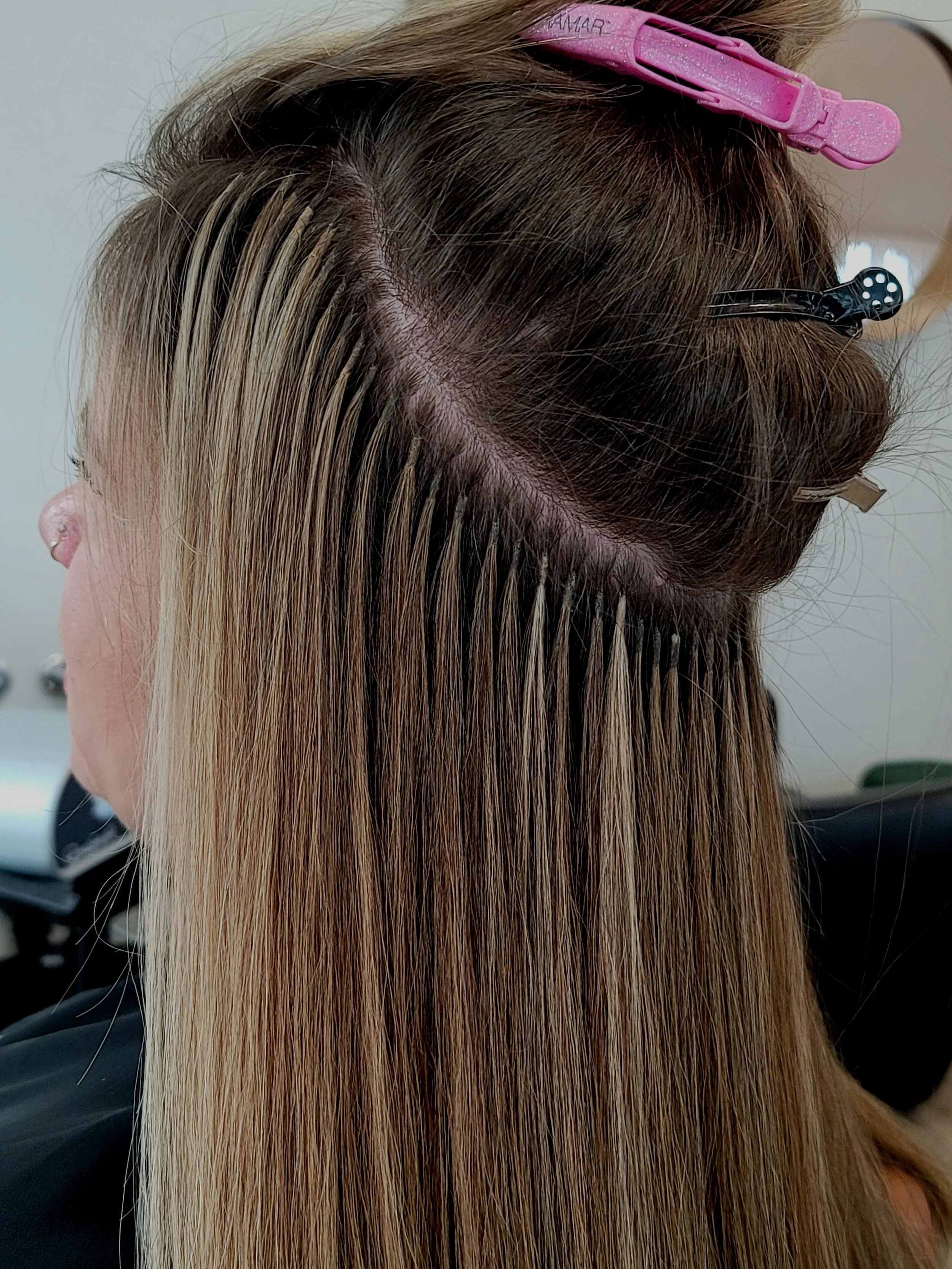
Cold fusion uses individual keratin tipped strands of hair — typically between 50 and 300 bonds depending on the look you're going for — that are attached to your natural hair using UV activated keratin. No heat. No glue guns. No wax. Just a copolymeric keratin compound resembling human hair.
Each bond is placed individually, which means the placement is completely customized to your hair density. Where your hair is thinner, we place fewer and smaller bonds. Where you want more volume, we add more. The result is a completely bespoke application that works with your specific hair pattern rather than against it.
Because each strand moves independently, cold fusion extensions give you 360 degree movement which means you can wear your hair up, down, in a ponytail, or braided back without any tracks, beads, or wefts showing. That freedom is one of the biggest reasons my clients choose Great Lengths over everything else.
What weft extensions are
Weft extensions , whether hand-tied, machine, or beaded , involve rows or tracks of hair sewn or beaded onto horizontal sections of your natural hair. Instead of individual bonds, you're working with a curtain of hair attached along a line.
Wefts can be beautiful when done well. They're often faster to install and can be a more accessible price point. But there are real limitations worth understanding.
The honest differences
For Movement and versatility Cold fusion wins here. Individual bonds move like your natural hair because they're attached individually. Wefts move as a unit, which is fine for wearing your hair down, but wearing it up or pulled back requires more planning to keep the tracks hidden.
Hair health is where I have strong feelings. Wefts, particularly beaded and sewn-in methods create tension along a horizontal track. Over time that consistent tension on the same line of hair can cause traction stress at the root. Cold fusion distributes weight across many individual points rather than concentrating it along a track, which is significantly gentler on your natural hair long term. Fusion extensions also have the ability for your hair density to be matched with each bond, whereas with a weft its much harder to take that into consideration.
I've had clients come to me after years of weft extensions dealing with thinning along their part line and temples. That's not a coincidence. They are also very quick to comment on how much lighter the bonds feel on their head, vs wearing a full row.
Maintenance Cold fusion bonds don’t need to be moved up as your natural hair grows. They grow out with your hair and then get completely removed every 3-6 months. Wefts need to be repositioned consistently with move-up appointments and re-installs.
Who each method suits Cold fusion is ideal for clients who want the most natural result, wear their hair up regularly, have finer hair that needs gentle attachment, or are wanting specific areas filled in and don’t need a full head of hair installed.
Wefts can work well for clients with thicker, coarser hair that can support the track tension, who primarily wear their hair down, or who are looking for a faster install time.
Why I specialize in cold fusion exclusively
I've been behind the chair for 18 years. I've seen what different extension methods do to hair over time. The reason I choose to offer Great Lengths cold fusion K-tips exclusively — and nothing else — is because it's the method I trust completely with my clients' hair.
I'm not interested in offering every method on the market. I'm interested in being exceptional at the one that consistently delivers the best long term results. That's what my clients deserve and that's the standard I hold myself to.
If cold fusion is right for you, I'd love to be the person who does it.
Book your Great Lengths consultation in Edmonton
Every consultation starts with your hair, your lifestyle, and your honest questions. We'll talk through whether cold fusion is the right fit for you and build a plan from there.
Great Lengths Hair Extensions in Edmonton: What You Need to Know Before You Book
Not all Great Lengths applications are created equal. Before you book extensions anywhere in Edmonton, here’s what a certified specialist wants you to know.
There's a reason Great Lengths has been the gold standard in hair extensions for over 30 years ( We created keratin bonding in 1993). And there's a reason I chose to specialize in them exclusively.
But before you book a consultation anywhere in Edmonton, there are a few things you should understand, because not all Great Lengths applications are created equal, and your hair deserves better than a rushed install from someone who does extensions as an afterthought or just wanting to jump on a fad.
What makes Great Lengths different
Great Lengths uses 100% ethically sourced human hair. Hair is donated as a religious sacrifice from temples in India. These temples then auction off the hair and the money goes back into the community to provide food, education and build orphanages. Every strand can be traced back to its original donor. The hair is then taken to Italy where it goes through reverse Osmosis ( the process to de pigment cashmere) to colour the hair and manufactured into perfectly weighted pre-bonded bundles. No glue. No wax. No Silicone coating. Just the most luxurious feeling hair that wont fade or shrink over time.
The result is extensions that moves and looks like your real hair, because in every way that matters, they are.
What cold fusion actually means for your hair health
Traditional hot fusion extensions use a heating tool to melt a keratin bond onto your hair. The problem is heat — even controlled heat — causes stress on the hair shaft over time. Cold fusion eliminates that entirely. The bond cures through UV pulses, not temperature, which means zero thermal damage at the attachment point.
The UV activated cold fusion process bonds the keratin directly to your natural hair at a molecular level. That means the bond is flexible, lightweight, and works with your hair instead of against it. It swells and contracts like real hair to prevent damage where the bond is.
After 18 years behind the chair, I've seen the difference this makes in long term hair health. Clients who come to me after years of hot fusion extensions are often shocked by how much their hair has thinned at the root. Cold fusion clients don't have that story.
Why colour matching matters more than you think
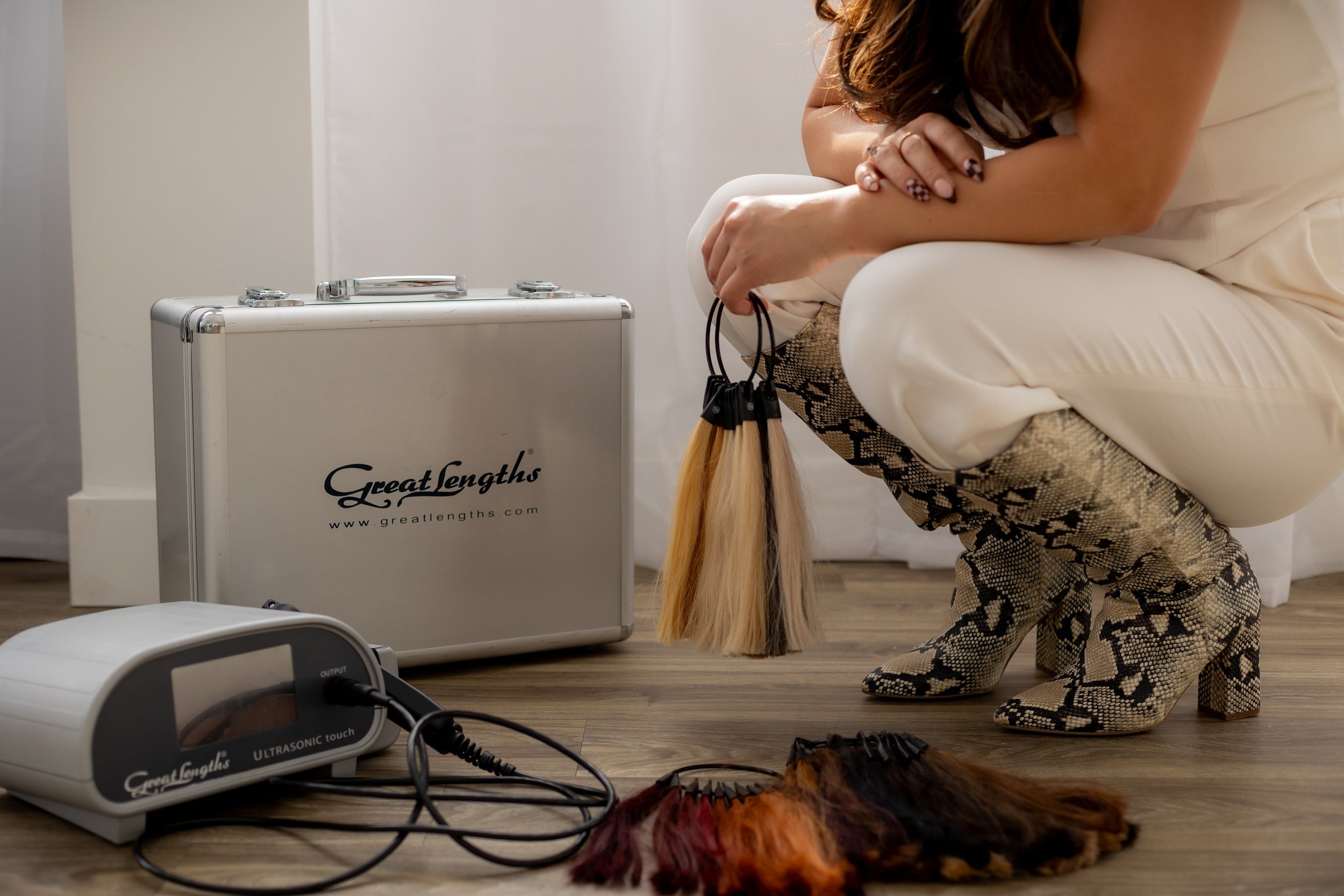
Great Lengths offers over 100 tones — not the 14 or 20 shades you'll find with lesser extension brands. That range exists because human hair is complex. Your natural hair isn't one colour, it has depth, dimension, and movement. A proper colour match accounts for all of it.
When I do a Great Lengths consultation, I'm not just matching your ends. I'm looking at your root colour, your mid-shaft, all the different tones in your hair, and where your natural dimension lives. That's what creates extensions that are genuinely undetectable.
What to expect at a Great Lengths consultation in Edmonton
Your consultation is where everything starts. We'll talk about your hair goals, assess your natural hair's density and health, map out a placement plan, and do a full colour match from the Great Lengths library.
No two installs are the same. The number of bonds, the placement, the lengths, all of it is customized to your hair specifically. This is not a one-size-fits-all service and any specialist worth booking treats it that way.
What makes a Great Lengths specialist different from a general extension stylist
Great Lengths doesn't sell their hair to just anyone. Certified specialists complete formal training and are held to application standards that protect both the client and the integrity of the brand. When you book with a certified specialist you're not just getting better hair , you're getting someone who is accountable to a standard.
I've been a certified Great Lengths specialist for years and it remains the only extension method I offer, because it's the only one I trust completely with my clients' hair.
Ready to book your Great Lengths consultation in Edmonton?
If you've been thinking about extensions and want to do it right the first time, I'd love to talk. Every consultation starts with your hair, your lifestyle, and your goals and ends with a plan that's built around you.